Color Blast: Block Shooter
- 4.7
- Rating
- 500.00K
- Installs
- Free
- Price

 Analysis by App-foxy
I spent time with Color Blast: Block Shooter as a quick, touch-focused puzzle game, and my first impression was clear: it is built for short bursts rather than long, story-driven sessions. The idea is easy to understand, the visual goal is immediate, and the free entry point makes it simple to try without committing money first. That straightforward design is also the reason it will not suit everyone. Players who enjoy calm tapping and visual clearing may find it pleasantly absorbing, while anyone looking for deep planning, narrative progress, or a large collection of modes may want something more substantial.
The game comes from XGame HK and sits in the puzzle category. Its store presentation focuses on tapping, shooting, and colorful block-clearing with a relaxing ASMR flavor. In my experience, that combination makes the game feel more like a pocket reset between tasks than a title I would open for a long competitive session. It is the kind of game I can imagine using while waiting for an appointment, taking a short break from work, or winding down without having to remember complicated controls.
How the free model affects the value
The basic download is free, which is the most important part of the value equation here. I could approach it as a trial rather than a purchase decision: install it, see whether the tapping rhythm and color effects suit me, and remove it if the loop becomes repetitive. The listed in-app purchase range runs from $1.99 to $99.99 per item, so the free starting point should not be confused with an entirely purchase-free experience. Anyone who is careful with spending should treat optional purchases as a separate decision and avoid assuming that paying is necessary to understand the game.
You May Also Like

 Blood Strike: 2.5 Anniversary
Blood Strike’s Loadouts Turn Every Drop Into a Tactical Gamble
A close look at Blood Strike’s custom loadouts: how fast access to signature weapons reshapes its battle royale rhythm, rewards preparation, and narrows the gap between fights.

 Pandora - Music & Podcasts
Pandora’s Music Is Easy to Start, but Harder to Recover
Pandora’s strength is its low-effort path from a seed to a station. Its weak spot is how much confidence it asks you to place in connection, setup, and quiet recovery.

 8 Ball Pool
 Is Built on Rivalries, Rematches, and Routine
A close look at the rivalries, rematches, shared routines, and unanswered safety questions that turn a quick pool match into a persistent mobile community.

 Samsung Music
’s Quiet Strength Is Playing What You Already Own
Its reach comes less from spectacle than from dependable access to a personal library. That simplicity is both the app’s strongest retention engine and its ceiling.

 AccuWeather: Weather Radar
AccuWeather Review: A Quick, Clear Forecast for Everyday Decisions
For everyday plans, the best forecast is the one you can understand quickly. AccuWeather makes rain timing, radar, and local conditions easy to act on, with a few trade-offs.

 Hill Climb Racing
Why Hill Climb Racing Still Turns Crashes Into One More Run
A tiny car, a bumpy hill and one more upgrade: Hill Climb Racing keeps resurfacing because its simple chaos makes every near-miss feel personal.
More From Our News Desk
View All News


That pricing spread makes restraint useful. For a casual puzzle title, I would not spend simply because a level feels slow or because a visual effect is appealing. I would first establish whether I am still enjoying the core action after several short sessions. Since the game is free to access, there is little reason to rush into a purchase. The sensible workflow is to play naturally, decide whether the experience earns a place on the phone, and only then consider whether any available item solves a problem I actually have.
The game is suitable for Everyone, which matches its uncomplicated presentation and makes it easier to recommend as a family-friendly casual option. It requires Android 8.0 or later, so compatibility is reasonably broad for people using older supported devices, although anyone with a very old phone should still check the operating system before installing. The current version is 3.0.4, a detail worth checking in the store when troubleshooting because behavior can change between updates.
Its audience is already fairly large, with over 500 thousand installs and an average rating of 4.7 from around 11 thousand ratings. I see that as a useful sign of broad appeal, not proof that every player will enjoy it. Puzzle games are personal: some people like a gentle, predictable loop, while others quickly notice repetition. The rating suggests that the central experience works for many players, but my own decision would still depend on whether I wanted relaxation or challenge.
The core loop is easy to enter
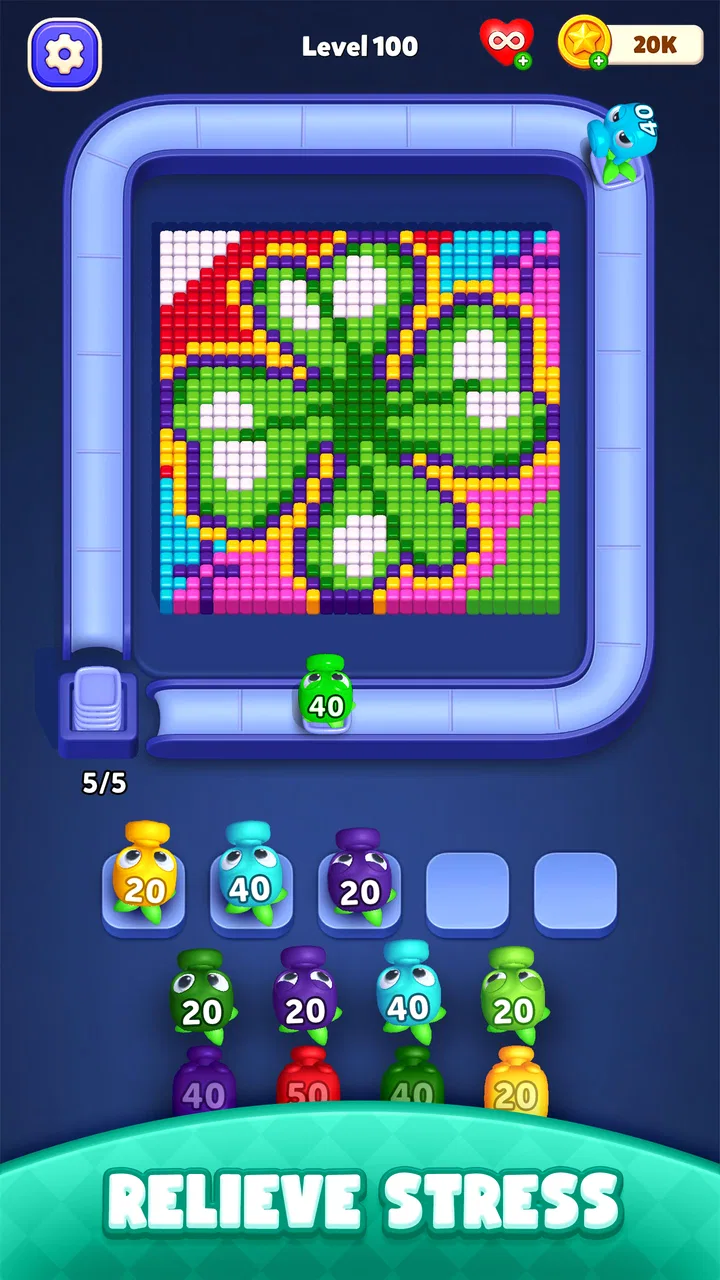
The best part of the design is how little explanation it needs. The title and visual presentation tell me what to do before I have invested much time: tap to fire and work through colorful blocks. That low learning curve matters on a phone, where a game often has only a few seconds to earn attention. I do not need to study a long tutorial or memorize a complicated control scheme before getting started.
The touch-first format also makes it approachable for people who do not normally play puzzle games. A user can pick it up with one hand and understand the immediate objective through the screen itself. That makes it more convenient than traditional match-three games for someone who does not want to manage several layers of menus, boosters, missions, or collection systems. The trade-off is that simplicity can reduce the sense of discovery over time.
I found the color and impact feedback important to the feel of each action. The game is not relying only on abstract numbers; it presents clearing as a visible little event. That is where the ASMR angle has practical value. The visual response can make a basic tap feel more satisfying, particularly when I am using the game to relax rather than to chase a demanding score.
Still, I would not mistake the soothing presentation for a completely passive experience. Puzzle games built around shooting blocks can become more engaging when I pause briefly and consider the order of my actions instead of tapping without thought. A useful habit is to scan the arrangement first, identify the area that will open the most space, and then act. That small pause gives the game more structure and helps prevent the session from becoming mindless repetition.
Small habits that make short sessions better
My first practical tip is to use it as a deliberate break, not as an endless background activity. A five-minute session has a clear purpose: reset attention, enjoy the color effects, and stop before the loop feels stale. If I keep tapping simply because the next stage is available, the relaxing quality can turn into fatigue. The game works best when I decide in advance whether I want a quick distraction or a longer attempt.
A second tip is to lower expectations about strategic depth. I would approach this as a light puzzle shooter, not as a replacement for a complex logic game. That mindset improves the experience because I can appreciate the immediate feedback without demanding a large tactical system from it. Players who enjoy difficult deduction, elaborate board manipulation, or carefully balanced competitive play may find more satisfaction in a traditional puzzle alternative.
A third useful approach is to test it in different everyday situations. With sound enabled, the audiovisual feedback may contribute more to the calming mood; with sound reduced or disabled, the game becomes a quieter visual diversion. I would try it during a commute, in a waiting room, or between household tasks and notice whether the short-loop structure feels refreshing or repetitive. That personal test is more informative than relying only on the rating.
There is also a practical spending lesson here. Because the download is free and the purchase options extend from a low single-digit amount to a much higher item price, I would never buy while distracted or frustrated. I would ask whether the purchase changes the way I enjoy the core puzzle or merely extends a session I was already ready to end. If the latter is true, keeping the free version is the better value.
Where the experience may lose momentum
The main limitation is the narrow promise. Colorful block shooting and relaxing feedback can be appealing, but they do not automatically create long-term variety. If the available play remains close to that central action, a player who needs new rules, story objectives, or intense competition may run out of reasons to return. I noticed that the same simplicity that makes the game welcoming can also make it feel lightweight beside deeper puzzle releases.
That is not a flaw for every audience. In fact, adding too many systems could damage what makes this appealing: the ability to open it and start immediately. The important trade-off is between accessibility and longevity. I would recommend it to someone who values frictionless play, but I would steer a dedicated puzzle enthusiast toward a more complex alternative if they want layered strategy and a stronger feeling of mastery.
The ASMR-style presentation is another matter of taste. Some players enjoy repeated visual and tactile feedback because it creates a calming rhythm. Others may find bright effects or repeated impacts overstimulating, especially when they are trying to relax in a quiet environment. I would test the game with the phone’s media volume adjusted rather than assuming that the same presentation works equally well for everyone.
The free model can introduce its own friction. Even without paying, I may become more aware of purchase prompts or of the difference between simply playing and seeking faster progress. Since the available items have a wide price range, families should be especially careful with purchase controls on shared devices. The Everyone rating describes the content audience, but it does not remove the need for sensible spending boundaries.
Another limitation is that this is not the right choice when I want a game that respects a long, uninterrupted evening with a rich progression arc. I would choose a narrative puzzle adventure for that purpose. I would also choose a competitive puzzle game when I wanted rankings, direct comparison, or a high-pressure challenge. Color Blast: Block Shooter has a more modest job: give me a colorful, accessible activity that can fill a small gap in the day.
Who gets the most value from it
I think the strongest audience is casual players who want an immediate puzzle without a large mental commitment. It is a good fit for someone who likes tapping, visual clearing, and a calm rhythm but does not want to learn a complicated ruleset. It may also work well for a person returning to mobile games after a break, because the controls are easier to approach than a strategy title with many menus and resources.
It is particularly useful in fragmented time. Imagine waiting for a friend who is running late: I can play a few rounds, put the phone away when the conversation starts, and return later without needing to reconstruct a complicated storyline. The same applies to a short break after answering messages or finishing a household chore. That stop-and-start convenience is more valuable here than a large feature list would be.
Families may also appreciate the Everyone content rating, especially when looking for a colorful game without an adult-oriented premise. I would still supervise spending on a child’s device because the free download includes in-app purchase options. The game can be shared as a casual recommendation, but the payment settings deserve the same attention as they would in any free-to-start title.
I would skip it if my priority is maximum challenge. A player who wants puzzles that demand several moves of planning, punish mistakes sharply, or introduce complex mechanics may feel under-served. I would also skip it if I dislike repetitive audiovisual feedback or if I prefer games with a strong story. The fact that many people rate it highly does not change that basic mismatch of expectations.
Device compatibility is straightforward for people on Android 8.0 or newer, but I would still consider screen comfort and battery habits in everyday use. A bright, effect-heavy puzzle can be pleasant for a short session and tiring during a long one. I would use it in brief intervals, especially at night, rather than treating it as a game designed for hours of continuous play.
My recommendation after weighing the trade-offs
My verdict is to try the free version, but keep the decision deliberately small. The entry cost is zero, the controls are approachable, and the colorful block-clearing loop has enough immediate feedback to make short breaks enjoyable. I would recommend it to a friend who wants a relaxing puzzle diversion and does not need a deep campaign. The current 3.0.4 release and broad Android compatibility also make it a practical option for many supported phones.
I would not recommend paying automatically. The listed purchase range is too broad for me to treat every item as good value without knowing exactly how it affects a particular player’s experience. I would play first, identify whether the core loop remains enjoyable, and only consider spending if an item provides a benefit I genuinely want. For many casual users, the free access may be enough.
Overall, XGame HK has made a focused puzzle game rather than an all-purpose mobile entertainment package. That focus is its strength when I need a quick, colorful reset, and its weakness when I want variety, narrative, or serious strategic depth. The best reason to install it is not the promise of endless complexity, but the convenience of a simple game that can make a few spare minutes feel more playful.
For me, that earns it a qualified recommendation: download it if you enjoy tap-based puzzle action and relaxing visual feedback, test it in the free version, and stop there if the repetition arrives before the enjoyment does. Choose another puzzle game when your goal is deeper thinking or a longer-term challenge. Used on its own terms, it delivers a pleasant low-commitment experience without asking me to buy in before I know whether it fits my habits.
FAQs for Color Blast: Block Shooter
01What is Color Blast: Block Shooter, and how is it played?
Color Blast: Block Shooter is a casual puzzle game that combines block-breaking mechanics with colorful shooting challenges. You aim and launch shots at groups of blocks, trying to clear them before they reach the bottom or become impossible to remove. Each level generally requires planning, accurate aiming, and choosing the best angle rather than simply firing as quickly as possible. The controls are designed to be easy for beginners to understand.
02Is Color Blast: Block Shooter free to download and play?
The game is generally available as a free download, allowing players to begin playing without paying upfront. However, free versions of casual mobile games commonly include advertising, optional purchases, or both. These may be used to obtain extra attempts, boosters, coins, or other helpful features. Before downloading, it is worth checking the store listing for the current pricing, in-app purchase details, and whether the game offers an option to remove advertisements.
03Does Color Blast: Block Shooter require an internet connection?
Some parts of Color Blast: Block Shooter may work without a constant internet connection, which is useful when playing during travel or in areas with limited service. Nevertheless, an online connection may still be needed for advertisements, purchases, cloud features, updates, event content, or synchronization. Offline availability can also vary between versions and devices, so players should test the game after installation rather than assuming every feature will remain accessible without internet.
04Is Color Blast: Block Shooter suitable for children and casual players?
Color Blast: Block Shooter is easy to pick up because its core gameplay relies on simple tapping, aiming, and shooting controls. The colorful presentation and short levels make it suitable for casual players who want quick entertainment. Parents should still review the age rating, advertising behavior, and in-app purchase settings before allowing children to play. Difficulty may increase as levels progress, so younger players could occasionally need assistance with more complicated stages.
05What should I know about advertisements, purchases, and device performance?
Players should expect that Color Blast: Block Shooter may use advertisements to support its free model, with ads potentially appearing between levels or when optional rewards are selected. In-app purchases may also be available for boosters, extra lives, currency, or an ad-free experience. Performance is usually best on a reasonably modern Android or iOS device with sufficient free storage. Keeping the operating system and game updated can help reduce crashes and compatibility problems.
Pros
- Simple tap-to-shoot controls are easy for beginners to learn.
- Bright colors and clean visuals make the board easy to read.
- Short levels fit well into quick gaming sessions.
- Gradual difficulty provides a steady challenge as you progress.
- Offline play is useful when you have no internet connection.
Cons
- Repeated shooting patterns can make later levels feel predictable.
- Mistakes may be frustrating when carefully planned moves are required.
- The game offers limited variety beyond its core block-shooting mechanic.
- Ads may interrupt play
- depending on the version and device settings.
- Players seeking deep strategy or story content may find it too basic.

Color Blast: Block Shooter
Gallery